Connect with us

CELEBRITY

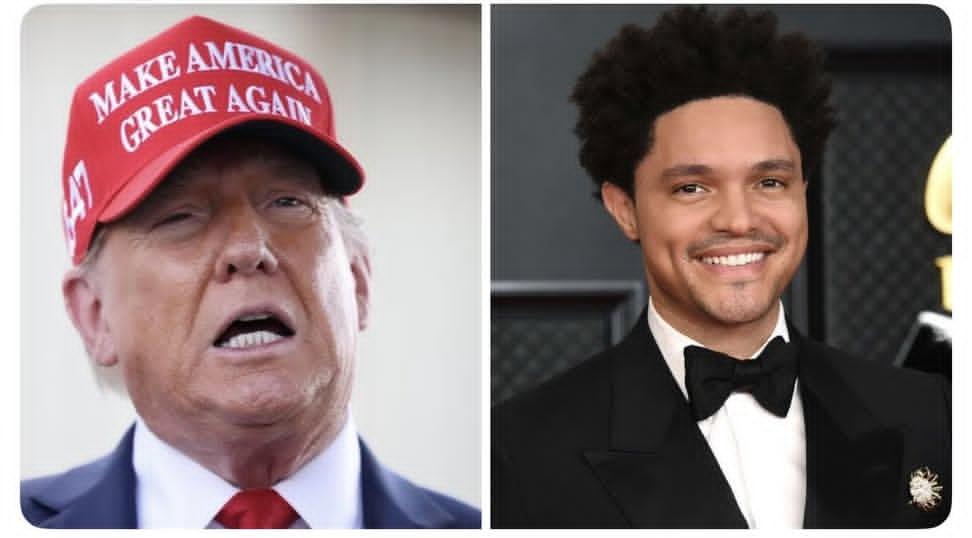
JUST IN: President Trump says he will sue Grammy host Trevor Noah for claiming he visited Epstein Island.

Published

on

JUST IN: President Trump says he will sue Grammy host Trevor Noah for claiming he visited Epstein Island.

A fresh political and cultural firestorm has erupted after former U.S. President Donald Trump publicly threatened legal action against Grammy Awards host Trevor Noah, accusing him of spreading a damaging and false claim involving the infamous Jeffrey Epstein.

The controversy exploded within hours of the Grammys broadcast, sending shockwaves across political circles, entertainment media, and social platforms—where reactions quickly split into outrage, disbelief, and intense speculation.

At the center of the storm is one explosive allegation: that Trevor Noah, while hosting the globally watched awards show, suggested or implied that Trump had visited Epstein Island—an island long associated with wealth, power, secrecy, and some of the darkest allegations in modern history.

JUST IN: President Trump says he will sue Grammy host Trevor Noah for claiming he visited Epstein Island.

Trump’s response was swift. And furious.
“I have never been to Epstein Island,” Trump said bluntly in a statement that quickly went viral. “I will be sending my lawyers to sue this poor, pathetic, talentless dope.”

Those words alone were enough to ignite a political inferno.
Almost instantly, headlines flooded the internet. Clips of the Grammys moment were replayed endlessly.

Supporters of Trump accused Noah of reckless defamation. Critics of Trump questioned why the remark struck such a nerve. And legal analysts began asking the same question everyone else was thinking: Did Trevor Noah cross a line?

Jeffrey Epstein’s name remains one of the most radioactive in public discourse. His private island, often referenced as “Epstein Island,” has become a symbol of alleged elite misconduct, secrecy, and unanswered questions. Any public figure even loosely associated with it faces immediate reputational damage—regardless of evidence.

That’s why Trump’s denial came with such intensity.

According to Trump, the claim is not just false, but deliberately harmful. Sources close to his camp describe the remark as “character assassination disguised as comedy,” arguing that the Grammys—a platform meant to celebrate music—was improperly used to push a political narrative.

So far, Trevor Noah has not issued a formal response.

That silence is only fueling the speculation.

Was the comment meant as satire? A joke taken out of context? Or something more deliberate?

Comedy has long occupied a gray area where exaggeration and political commentary intersect.

But when jokes touch real people, real allegations, and real trauma, the stakes change dramatically. Legal experts say that if Trump follows through with a lawsuit, the case would likely hinge on intent, context, and whether the statement could reasonably be interpreted as factual.
Meanwhile, social media has become a battleground.

Hashtags related to Trump, Trevor Noah, Epstein Island, and the Grammys trended simultaneously. Some users defended Noah, arguing comedians should be free to criticize powerful figures. Others argued that invoking Epstein—without evidence—crosses an ethical and legal line.

The Grammys organization has yet to release a statement addressing the controversy.

Behind the scenes, insiders say network executives are “closely monitoring” the fallout. Award shows have increasingly become lightning rods for political moments, but few generate legal threats of this magnitude.
For Trump, this isn’t just about reputation—it’s about control of the narrative.

He has repeatedly denied any improper association with Epstein beyond public social circles, and has emphasized that he was never on Epstein’s island. Any suggestion otherwise, he argues, unfairly ties his name to crimes and allegations he has consistently rejected.
What happens next could set a precedent.

If Trump files suit, it may force uncomfortable questions into the spotlight: about comedy, responsibility, media boundaries, and how far public figures can go when referencing real-world scandals for entertainment.
If he doesn’t, critics may frame the threat as political theater.
Either way, the damage—or momentum—has already begun.

One thing is certain: a single line spoken on a glittering awards stage has now spiraled into a national controversy involving lawyers, reputations, and one of the most sensitive topics imaginable.

And as the silence from Trevor Noah continues, the question grows louder:
Was it just a joke—or the opening shot of a legal war no one saw coming?
Stay tuned.
Taylor Swift Breaks Silence on the “Foul Smell” During Recent Interview With Trump After Grammys Snub: “It Really Does Stink”
CELEBRITY1 minute ago

Taylor Swift Breaks Silence on the “Foul Smell” During Recent Interview With Trump After Grammys Snub: “It Really Does Stink”

Trump Installs an Escalator on Air Force One, Claims He’s the First President Ever to Use This “Advanced Technology”
NEWS28 minutes ago

Trump Installs an Escalator on Air Force One, Claims He’s the First President Ever to Use This “Advanced Technology”

JUST IN: Taylor Swift Breaks Down in Tears After the Grammys Committee Revokes Her Awards and Orders Them Returned
CELEBRITY2 hours ago

JUST IN: Taylor Swift Breaks Down in Tears After the Grammys Committee Revokes Her Awards and Orders Them Returned

JUST IN: President Trump says he will sue Grammy host Trevor Noah for claiming he visited Epstein Island.
CELEBRITY6 hours ago

JUST IN: President Trump says he will sue Grammy host Trevor Noah for claiming he visited Epstein Island.

Serena Williams at the Grammys With a Scar on Her Face: Is It Fashion or Something More Disturbing? See Full Details and Photos
CELEBRITY7 hours ago

Serena Williams at the Grammys With a Scar on Her Face: Is It Fashion or Something More Disturbing? See Full Details and Photos

CHAOS at the Grammys: Taylor Swift Caught in Heated Fight - Here's What Really Happened
CELEBRITY18 hours ago

CHAOS at the Grammys: Taylor Swift Caught in Heated Fight – Here’s What Really Happened

Taylor Swift at the Grammys With a Scar on Her Face: Is It Fashion or Something More Disturbing? See Full Details and Photos
CELEBRITY19 hours ago

Taylor Swift at the Grammys With a Scar on Her Face: Is It Fashion or Something More Disturbing? See Full Details and Photos

Ivanka Trump Breaks Her Silence After Years of Questions, Alleged Tapes, and Unsettling Clues From Her Childhood Surface — What She Says Happened, Why She Stayed Quiet for So Long, and Why Americans Are Now Rewatching an Old Bedroom Video With New Eyes
NEWS19 hours ago

Ivanka Trump Breaks Her Silence After Years of Questions, Alleged Tapes, and Unsettling Clues From Her Childhood Surface — What She Says Happened, Why She Stayed Quiet for So Long, and Why Americans Are Now Rewatching an Old Bedroom Video With New Eyes

30 MINUTES AGO: Trump Secretly Offered Shohei Ohtani $1 Billion to Defect to the Yankees – 'We'll Make Baseball Great Again... Starting with the Bronx!
NEWS22 hours ago

30 MINUTES AGO: Trump Secretly Offered Shohei Ohtani $1 Billion to Defect to the Yankees – ‘We’ll Make Baseball Great Again… Starting with the Bronx!

Trump Just Dropped the Ultimate Bombshell: 'Shohei Ohtani Is Secretly Joining My Inner Circle — And He’s Bringing the 50-50 Magic to Fix America!
NEWS22 hours ago

Trump Just Dropped the Ultimate Bombshell: ‘Shohei Ohtani Is Secretly Joining My Inner Circle — And He’s Bringing the 50-50 Magic to Fix America!

Philadelphia has moved into uncharted territory, introducing legislation that would sharply restrict how Immigration and Customs Enforcement operates within the city, signaling one of the most aggressive municipal challenges to federal immigration enforcement in recent memory. The proposal, unveiled amid rising national tension over immigration tactics, would fundamentally change the rules of engagement for ICE agents on Philadelphia streets. At the center of the legislation is a demand for visibility and accountability. Under the proposed rules, ICE agents would no longer be allowed to conceal their faces while operating in public. Masks, balaclavas, and other face coverings that obscure identity would be prohibited, and agents would be required to clearly display official identification at all times. City officials backing the measure argue that law enforcement wielding immense power should never be anonymous, especially in neighborhoods already strained by fear and mistrust. But the bill goes further, striking at the core of how immigration enforcement is carried out. ICE agents would be barred from conducting operations in Philadelphia without a warrant signed by a judge. Administrative paperwork or internal federal authorizations would no longer suffice. Supporters of the legislation say this is about restoring constitutional guardrails, ensuring that arrests and detentions meet the same judicial standards expected of any other law enforcement action that deprives a person of liberty. Perhaps the most explosive provision is the one drawing the most attention nationwide. If ICE agents engage in violence against bystanders, the legislation states, they will be arrested. No carve-outs. No special exemptions based on federal status. The message is unmistakable: federal authority does not grant immunity from local criminal law when civilians are harmed. City leaders framing the bill describe it as a necessary response to what they characterize as increasingly aggressive and opaque enforcement tactics. They argue that unmarked vehicles, masked agents, and sudden street arrests have created chaos and fear, often ensnaring not just targets but entire communities. According to proponents, this legislation is about restoring order, predictability, and basic civil rights, not obstructing the law. Opponents see it very differently. Critics warn that Philadelphia is inviting a direct confrontation with the federal government and setting the stage for a legal showdown that could end up in federal court. They argue that immigration enforcement is a federal responsibility and that cities lack the authority to dictate how federal agents operate. Some law enforcement voices have also raised concerns about officer safety, claiming that requiring agents to show their faces and identities could expose them to retaliation. Yet supporters counter that local police already operate under those exact conditions every day. They argue that transparency has not crippled city policing, and that the same standards should apply to federal agents interacting with civilians in public spaces. In their view, the risk to public trust posed by anonymous, masked enforcement far outweighs the operational inconvenience claimed by ICE. The political context surrounding the legislation is impossible to ignore. Across the country, cities and states are increasingly pushing back against federal immigration practices, citing concerns over civil liberties, racial profiling, and the erosion of community trust. Philadelphia’s proposal stands out not just for its scope, but for its bluntness. It does not merely discourage cooperation with ICE; it attempts to redefine the boundaries of acceptable conduct within city limits. Reaction from immigrant advocacy groups has been swift and emotional. Many describe the proposal as a long-overdue line in the sand, one that tells residents they will not be left defenseless when confronted by unidentified agents. For families who have lived with the constant fear of sudden detention, the promise of judge-signed warrants and visible identification feels like a measure of dignity restored. At the same time, federal officials and their allies are signaling that they may not accept the restrictions quietly. Questions are already swirling about enforcement, compliance, and what happens if ICE agents simply refuse to follow the city’s rules. Legal scholars note that while cities cannot nullify federal law, they can enforce their own criminal statutes, especially when it comes to assault, unlawful detention, and public safety. As the legislation moves forward, Philadelphia finds itself at the center of a national reckoning over power, accountability, and the limits of federal authority on local streets. Whether the bill ultimately survives legal challenges or sparks retaliation from Washington remains uncertain. What is clear is that the city has issued a bold declaration: enforcement in Philadelphia will no longer happen in the shadows. If passed, the legislation would mark a dramatic shift in how immigration enforcement intersects with local governance. It would transform routine operations into high-stakes tests of compliance and force a long-avoided confrontation over who truly sets the rules when federal power meets city streets. In doing so, Philadelphia may have ignited a debate that reaches far beyond its borders, one that could redefine the balance between security, liberty, and accountability across the country.
NEWS2 days ago

BREAKING:- Philadelphia introduced legislation to limit ICE. Agents can’t be masked, must show ID, and can only operate on warrants signed by a judge. If they attack bystanders, they will be arrested

The Justice Department has DELETED all the files which had various allegations against Trump, including rape and trafficking in the newly released Epstein files
NEWS2 days ago

The Justice Department has DELETED all the files which had various allegations against Trump, including rape and trafficking in the newly released Epstein files

Copyright © 2025 Newsgho