
CELEBRITY
JUST IN: President Trump says he will sue Grammy host Trevor Noah for claiming he visited Epstein Island.

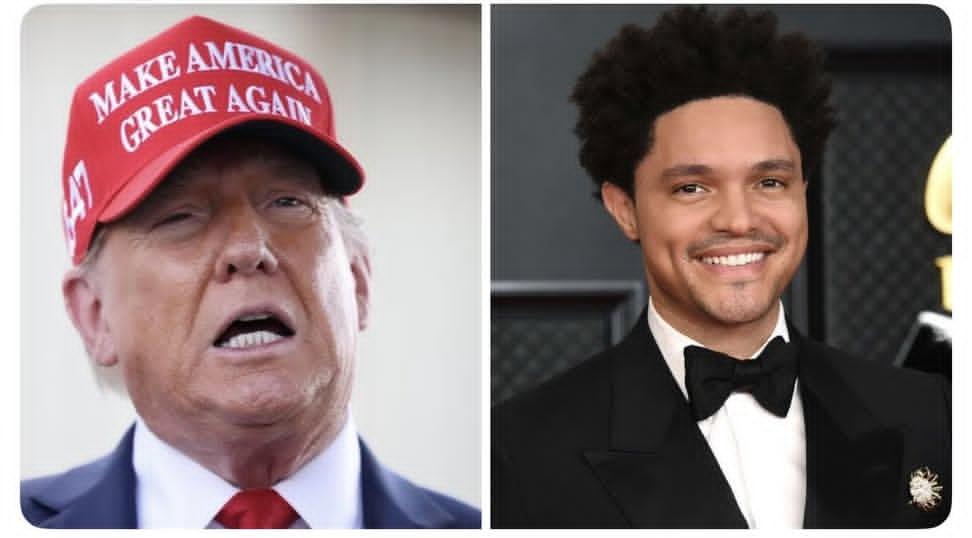
A fresh political and cultural firestorm has erupted after former U.S. President Donald Trump publicly threatened legal action against Grammy Awards host Trevor Noah, accusing him of spreading a damaging and false claim involving the infamous Jeffrey Epstein.
The controversy exploded within hours of the Grammys broadcast, sending shockwaves across political circles, entertainment media, and social platforms—where reactions quickly split into outrage, disbelief, and intense speculation.
At the center of the storm is one explosive allegation: that Trevor Noah, while hosting the globally watched awards show, suggested or implied that Trump had visited Epstein Island—an island long associated with wealth, power, secrecy, and some of the darkest allegations in modern history.
Trump’s response was swift. And furious.
“I have never been to Epstein Island,” Trump said bluntly in a statement that quickly went viral. “I will be sending my lawyers to sue this poor, pathetic, talentless dope.”
Those words alone were enough to ignite a political inferno.
Almost instantly, headlines flooded the internet. Clips of the Grammys moment were replayed endlessly.
Supporters of Trump accused Noah of reckless defamation. Critics of Trump questioned why the remark struck such a nerve. And legal analysts began asking the same question everyone else was thinking: Did Trevor Noah cross a line?
Jeffrey Epstein’s name remains one of the most radioactive in public discourse. His private island, often referenced as “Epstein Island,” has become a symbol of alleged elite misconduct, secrecy, and unanswered questions. Any public figure even loosely associated with it faces immediate reputational damage—regardless of evidence.
That’s why Trump’s denial came with such intensity.
According to Trump, the claim is not just false, but deliberately harmful. Sources close to his camp describe the remark as “character assassination disguised as comedy,” arguing that the Grammys—a platform meant to celebrate music—was improperly used to push a political narrative.
So far, Trevor Noah has not issued a formal response.
That silence is only fueling the speculation.
Was the comment meant as satire? A joke taken out of context? Or something more deliberate?
Comedy has long occupied a gray area where exaggeration and political commentary intersect.
But when jokes touch real people, real allegations, and real trauma, the stakes change dramatically. Legal experts say that if Trump follows through with a lawsuit, the case would likely hinge on intent, context, and whether the statement could reasonably be interpreted as factual.
Meanwhile, social media has become a battleground.
Hashtags related to Trump, Trevor Noah, Epstein Island, and the Grammys trended simultaneously. Some users defended Noah, arguing comedians should be free to criticize powerful figures. Others argued that invoking Epstein—without evidence—crosses an ethical and legal line.
The Grammys organization has yet to release a statement addressing the controversy.
Behind the scenes, insiders say network executives are “closely monitoring” the fallout. Award shows have increasingly become lightning rods for political moments, but few generate legal threats of this magnitude.
For Trump, this isn’t just about reputation—it’s about control of the narrative.
He has repeatedly denied any improper association with Epstein beyond public social circles, and has emphasized that he was never on Epstein’s island. Any suggestion otherwise, he argues, unfairly ties his name to crimes and allegations he has consistently rejected.
What happens next could set a precedent.
If Trump files suit, it may force uncomfortable questions into the spotlight: about comedy, responsibility, media boundaries, and how far public figures can go when referencing real-world scandals for entertainment.
If he doesn’t, critics may frame the threat as political theater.
Either way, the damage—or momentum—has already begun.
One thing is certain: a single line spoken on a glittering awards stage has now spiraled into a national controversy involving lawyers, reputations, and one of the most sensitive topics imaginable.
And as the silence from Trevor Noah continues, the question grows louder:
Was it just a joke—or the opening shot of a legal war no one saw coming?
Stay tuned.







Looks Like His Wife Dresses Him’ — Fans Sense Taylor Swift in Travis Kelce’s Stylish Outfit for Chiefs Preseason Game 1

Taylor Swift and Brittany Mahomes plan to surprise their husbands and to support their game tonight…

NO LONGER THE RUMOR: Just one hour ago, Travis Kelce dropped the long-awaited announcement we’ve all been hoping for…

Travis Kelce flashes his wedding ring as he arrives for first Chiefs game tonight since marrying Taylor Swift… but his new wife is not spotted in the stands…

Travis Kelce Spotted on a Stroll With Wife Taylor Swift and a Baby Bump Just Weeks After Their Wedding, and Fans Are All Saying the Same Thing… See the Photos

BREAKING NEWS:Taylor Swift Tears Into Donald Trump After White House Files Lawsuit Against NBC Over SNL Mockery, Says the President Should “Worry About the Government Shutdown, Epstein Files, and Rising Food Prices” Instead of Comedy Sketches

Is That a Baby Bump?!” Taylor Swift’s Shocking New Instagram Photo Has Everyone Screaming — Travis Kelce’s Comment Says It ALL…

Taylor Swift Breaks Her Silence — and the Internet: The Pop Queen Marches in Massive ‘No Kings Day’ Protest After Donating $1M to Anti-Trump Demonstrators, Calling for the End of Political Dynasties, Monarchy Culture, and ‘Celebrity Silence’ in America.

NO LONGER THE RUMOR: Just one hour ago, Travis Kelce dropped the long-awaited announcement we’ve all been hoping for… 👇

Taylor Swift had her song “August” removed from a Team Trump TikTok account after it was used without her permission in a video showing Donald and Melania Trump watching fireworks…

Taylor Swift is making history again! ✌ Taylor is set to become the youngest artist ever to be inducted into The Nashville Songwriters Hall of Fame, joining the likes of Dolly Parton, Willie Nelson, Shania Twain and more legendary stars. The ceremony is expected to take place later this year.
