
NEWS
“WHAT HAPPENED TO ‘NO MORE WARS’??? — Trump Bombed Nigeria on Christmas Day, Revived an ISIS War He Once Declared ‘Over,’ Sent an Epstein-Tainted Holiday Message as Nigeria, Obama, Biden, and the Pope Erupted in Outrage”


“What happened to no more wars?” That was the question echoing across social media after Donald Trump announced that the United States military had carried out strikes in Nigeria on Christmas Day.
According to Trump, the operation targeted ISIS-linked militants operating in parts of the country, a claim that immediately ignited controversy both at home and abroad.
The timing alone raised alarms. Christmas Day is one of the most sensitive dates on the global calendar, especially for a country like Nigeria, which has a large Christian population and has already endured years of conflict involving extremist groups.
Trump’s announcement appeared abrupt, offering few details about the scope of the strikes, the level of coordination with Nigerian authorities, or the immediate consequences on the ground.
Nigerian officials and citizens quickly began demanding clarity, as online debates exploded over sovereignty, civilian risk, and whether the operation had been requested or imposed.
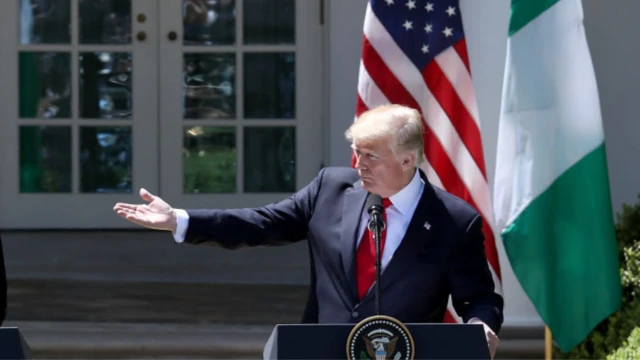
The announcement also reopened a long-standing contradiction surrounding Trump’s national security record. During and after his first term, Trump repeatedly claimed that ISIS had been “defeated” under his leadership.
That messaging became a central pillar of his “America First” and “no more endless wars” narrative. Critics were quick to ask how ISIS could simultaneously be finished and still require military action years later, especially in a new theater like Nigeria.
Supporters, meanwhile, argued that extremist groups evolve and rebrand, insisting the strikes were justified. The contradiction, however, fueled renewed skepticism.
What pushed the story further into chaos was Trump’s Christmas message following the announcement.
Instead of a traditional holiday statement, the message veered into attacks on political opponents and included an unexpected reference to Jeffrey Epstein. While Trump did not provide context or explanation, the mention alone was enough to spark confusion and outrage, particularly given Epstein’s association with scandal and the sensitivity of invoking such a figure on a religious holiday.
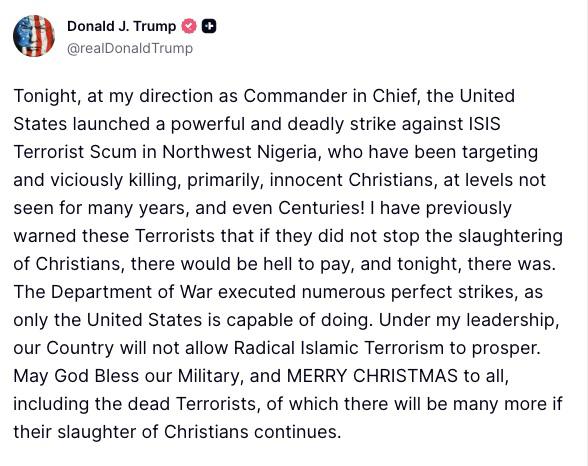
Many critics described the message as inappropriate and unsettling, while others questioned why it was necessary at all.
Reactions poured in rapidly. Nigerian voices dominated the conversation online, with many users expressing anger, fear, and frustration over being treated as a battleground in a foreign political narrative.
In the United States, figures associated with past administrations, including Barack Obama and Joe Biden, were dragged into the debate as comparisons and accusations flew across partisan lines.
Even the Pope’s name trended briefly, as religious leaders and commentators questioned the morality and symbolism of military action announced on Christmas.
As the outrage grew, a new layer of speculation emerged.
Insiders and commentators began pointing to Nigeria’s strategic importance, particularly its oil reserves. Nigeria is one of Africa’s largest oil producers, and critics suggested the strikes fit a broader pattern of aggressive interest in resource-rich regions under the banner of counterterrorism.
Claims surfaced that Trump may be seeking something in return for U.S. involvement, reigniting long-running concerns about whether security assistance is being tied to economic leverage rather than stability.
By the end of the day, what began as a brief military announcement had turned into a full-scale political storm.
The contradiction between “no more wars” and Christmas Day strikes, the unresolved ISIS narrative, the strange Epstein reference, and the growing oil motive speculation combined into a single, volatile moment. Whether the operation itself fades from headlines or becomes a defining flashpoint may depend on what details emerge next — and whether the questions raised can be answered at all.
For now, the backlash shows no sign of slowing, and the question remains louder than ever: if the wars were supposed to be over, why does it feel like another one just began?



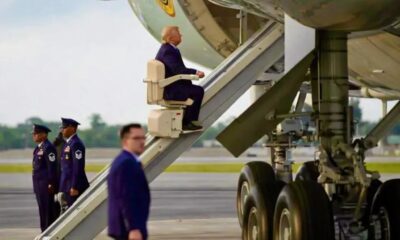




10 MINUTES AGO: Washington in Panic as President Donald Trump Shot Again While Exiting the White House and Urgently Rushed to the Hospital – Is This a Stunt to Distract from the Epstein Files? Here Are the Full Details

Furious Rep Melanie Stansbury Takes a Bold Move against Trump and his Associates in the Epstein Files after her recent interview, but she might not be safe after this move

BREAKING: Bad Bunny Files Stunning $500 Million Lawsuit Against Donald Trump, Claiming The President’s Super Bowl LX Halftime Remarks Were Made With “Actual Malice” and it’s Causing Severe Reputation Damage

Travis Kelce and Taylor Swift Turn Heads After Appearing at NFL Honors, and Fans Can’t Stop Talking About Taylor’s Unusually Elegant Silver Mini Dress… See Photos

Travis Kelce admitted to cheating on fiance Taylor Swift’s because…

Taylor Swift calls off engagement and wedding plans with Ex Travis Kelce and reveals one shocking reason why

“Why am I being dragged into this?”: Travis Kelce frustrated as Taylor Swift parents stops him from getting married to their daughter because of Austin

“Travis Has Crossed the Line” — Taylor Swift Breaks Her Silence and Reveals What Travis Kelce Did That She Says She Will Never Forgive

Taylor Swift Announces Her Mom and Dad Are Divorcing, Then Says “Travis and I Are No…” — Full Details

Taylor Swift Secretly Bought the Kansas City Chiefs for $14 Billion — Sources Say She Did It to “Protect Travis’s Legacy”

JUST IN: House Democrats are said to be only five votes short of moving forward with Trump’s impeachment, as political pressure rises and a single vote could shift the outcome in Washington.
